
Product

Everything between your frontend and your orders.

What the core owns, grouped the way the Admin is. Your client owns the pages, the routes and the design.

Catalog and pricing

Products, variants and options, published per Store and channel. Prices are exact net amounts selected by market, channel, customer group, quantity and schedule.

Products and variants

Options, media per variant, product types, tags and manual or automatic collections.

Markets and currencies

A market owns its countries, currency and tax mode. Locale never chooses a rate.

Regular and special prices

Scope overrides from global to channel; the lowest eligible special price wins.

Publication readiness

Publishing fails with field errors when a variant lacks a price, tax group or rate.

A product page on the reference storefront showing the contextual offer

Checkout and orders

Carts, exact tax, shipping, payment and promotions come from the core. Your frontend submits intent and displays the authoritative result.

Exact tax

Manual rates per jurisdiction, inclusive or exclusive, allocated by largest remainder so components always sum.

Promotions

Codes, automatic discounts, Buy X Get Y and shipping discounts, with explicit combination rules and budgets.

Immutable orders

Every order snapshots the prices, rates, discounts and inventory evidence that produced its totals.

Returns, exchanges and claims

Handled from the order, with refunds to the original payment or to store credit.

Checkout recovery

Abandoned checkouts are recorded and reminded by email from templates you control.

Payment providers

Provider callbacks are verified, idempotent and reconciled; a lost callback never loses an order.

Customers and B2B

Shopper accounts belong to a Store. Groups and segments drive prices and promotions; a trade portal is just another client of the same API.

Accounts and addresses

Registration, verification, recovery and address books, with server-held shopper sessions.

Groups and segments

Manual groups and rule-based segments for pricing, promotions and reporting.

Wholesale ordering

The wholesale client shows net pricing, quantity tiers and account ordering on the same backend.

Personal data access

Export and erasure requests are handled per Store with an audit trail.

Content and media

The CMS is in the core: pages, navigation, localized entries and content models, published separately from the catalog and invalidated in your frontend.

Pages and navigation

Editorial pages, menus and redirects per Store and locale.

Content models

Define your own entry types with fields, references and validation, then author against them.

Media library

Uploads go straight to S3-compatible storage; the core keeps the metadata and the variants.

Cache invalidation

Publishing tells your frontend which paths changed, so a CDN can cache aggressively.
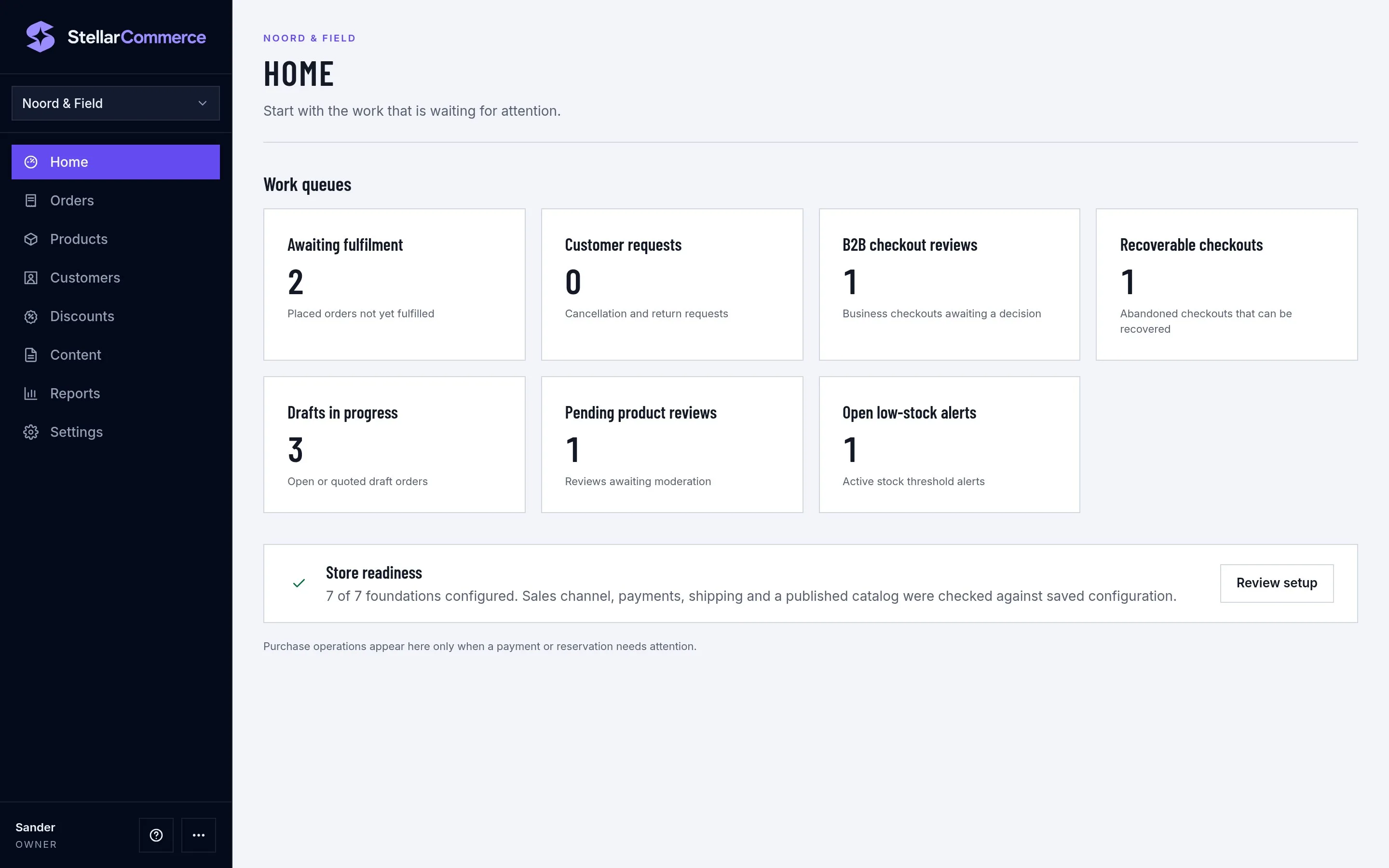
Operations

One Admin for the whole account, with the scope named on every page. The things you would otherwise bolt on are already there.

The Admin home page with work queues and the setup readiness card

Transactional email

Versioned templates per Store and locale, rendered and delivered through your provider with a full attempt log.

Webhooks and analytics

Signed, retried deliveries for events and a redacted analytics projection.

Product feeds

A Google Merchant Center feed generated from published catalog data.

Reports

Sales, products and customers over time, per Store and channel.

Team and roles

Invitations, per-Store roles, MFA with recovery codes, and a separate Platform operator login.

Saved views and spreadsheets

Save filters per person or device; import and export the catalog as a spreadsheet.

Developers

The boundary between the core and your code is one versioned OpenAPI contract and the SDK generated from it.

Store API

Publishable keys, sales channel selection and shopper sessions for the frontend.

Admin API

The same contract the first-party Admin uses, for integrations and automation.

TypeScript SDK

Generated, typed and Fetch-based. Works in Astro, Next, Node and the browser.

Astro starter

A downloadable storefront that walks from the first request to a completed order.

Documentation portal

Guides, recipes and the operation reference for your release, behind your account.

Self-hosting runbooks

Install, upgrade, backup, restore and first-Store activation, written for one operator.

See it on your own catalog.